Showing posts with label maintenance. Show all posts

Tuesday, August 8, 2023

Do not submerge your Nexus gear hub

Title says it all.  These things hold up great in rain and snow and filth, but really badly under water.

Funny thing, its rained a lot here recently.  So a family member was on the way home from work, and found that the river was invading the bike path.  We had a talk on the phone, and I failed to think very far ahead, which did generate some extra work and possibly lead to long-term damage to some bike components, but on the other hand, now I have had a new experience.

So the family member found a way through the flooded section that was acceptable for legs, but which saw the bike pushed through water that was way over the wheel centers.  In fact this was an electric bike, and the electrical-connector-end of the battery went in the river, plus the motor, and all the control circuits.  Did you know an E-bike could survive that?  I did not.

Anyway the bike was apparently making some funny noises when it got home, but only while pedaling.  I had also in the back of my mind the old Nexus 7 that a kid had (apparently) submerged in a forest, followed by neglect, events that accelerated the crapification process of that hub remarkably.  So the wheel came off, the hub guts came out, and it was quite wet inside.  I think a small amount drained out as I took it apart.  So it got a long tour at the end of the boot drier before re-greasing and re-assembly.

The hub seemed a bit under-greased, perhaps that made the water ingress worse.  This hub at the time of this writing is their latest Nexus 8 model, a SG-C6001-8C (coaster brake, regular bearings).  So it ought to have the best available seals.

So the next day I went to assist this family member on the way to work, so I could see that the bike was OK.  (It was after all an E-bike that got partially submerged, plus the hub I worked on.)  We came to an uninteresting little underpass that had a puddle in it.  Which was deeper than the wheel centers, this time on two bikes.  (I wonder how many bikes that claimed in the past couple days.)

So when I got back home, I had front and rear hubs to think about.  I wasn't really sure there was enough time under water to make a difference, probably under 10 seconds of submersion.  This was however my favorite Nexus 8, a SG-C6010-8R.  (It has the good bearings on the planet gears.)  So I took it all apart, and sure enough there was some water droplets in there.  Less water than the other hub, but not dry.  It also got a tour with the boot drier.

So anyway, approximately no submersion is acceptable for a Nexus 8, not even the latest models.

I don't actually know what the long-term effects of not taking action would have been.  Some internal rust, certainly on the first hub.  It also seemed low on grease, so it would probably have undergone rapid crapification.  Even with intervention, I can't be certain that these two didn't retain water deep inside where it will rust in the coming weeks and months.  (I have never taken hubs apart beyond exposing the innards as a unit.)  I also do not know what amount of water ingress is tolerable for these hubs.  They are designed to be used in wet conditions, and thats how I always use mine.  I have never had an internal rust issue except for the Nexus 7 that took a bath and subsequently neglected for a year or so.  That hub still lives in a kids bike.

I should also say that the front hub on one bike also needed new grease after all this bathing.  The other hub... is an electric motor that shows no outwards signs of harm.  Not something I am eager to take apart.  Fingers crossed.

Monday, February 6, 2023

Shimano Nexus in the cold

I've been a committed utility biker for at around 15 years now, probably every one of those years with freezing temperatures.  Freezing or sluggish shifter cables on gear hubs are a recurring nuisance that even 15 years of experience hasn't fully eliminated.  It is, by the way, always the cable that freezes.  If you have water in your hub such that it can freeze, its going to end badly.

The old hubs with shift boxes sticking out from the axle end are hopeless, IMO.  (For example the old SRAM P5 or S7, great hubs with shifters totally unsuited to winter.)  There are also some hubs that survive it all pretty easily, for example Rohloff, in my experience.  Most hubs though are from Shimano, or shift in a similar way, with one cable which you pull one way, and the hub pulls the other.  A component on the drive side of the hub rotates according to what the cable demands (and what the return spring can achieve).  These are the shifters that are worth writing about.

I have nailed down the ritual of getting water out of the cable housing.  Ideally a person has to do this just once in a year, or less.  Take the bike (or trike!) inside and melt it off (ideally overnight).  Disconnect the cable from the hub (doesn't take long if you know the motions), pull the cable out of the "cassette joint", take some toilet paper around the cable end, and hold this bundle in the end of a vacuum cleaner hose (running).  This pulls water out pretty well after a short time, which can be easily demonstrated with a bit of before-and-after testing in the cold outdoors (if you have time for playing around).  I used to use the vacuum to pull through some tri-flow oil, but in the end I don't think that achieved anything, might have even made things gummy.  I have also greased the cable as it is being inserted into the liner, again without any clear results.  If there is a rubber accordion at the cable end, I cut off the tip and pack it with grease.  (Those accordions not only fail to keep out water, but they potentially get wrapped around the cable pulley and throw off the shift points.)  I pack grease in everywhere as the cable is re-assembled, and then re-attached.

To clarify a bit with photos, here is the "cassette joint" for 4 hubs.  This component holds the end of the cable housing, so when the cable is pulled through the housing, a component on the side of the hub is compelled to rotate.

  CJ-8S40 on Nexus 8 SG-C6001-8C 
19t sprocket
  CJ-8S40 on Nexus 8 SG-8C31 
24t SRAM sprocket
   
  CJ-NX40 on Nexus 7 SG-C3000-7C 
24t SRAM sprocket
  CJ-8S40 on Nexus 8 SG-C6010-8R 
19t sprocket
 

note the accordion on the cable

Here we have some photos of one of the hubs where the rubber accordion has for some reason stuck to the cable in such a way that it pulled around the rotating component, and resulted in less rotation for a given cable movement.  This then resulted in the hub not quite finishing shifts correctly in the higher gears.

the accordion should certainly
not get pulled like this

A cable prepared in this way (vacuum and grease-packing) does shift between lowest and highest gear at temps well below freezing, the only trouble is that the spring in the hub may still return rather slowly.  Maybe one second behind the shifter motion.  This slow return sets in gradually as the temperature drops, which seems like grease or oil thickening, but not all my hubs show it.  In addition to the cable, there are internal hub components that need to move, as well as external surfaces that need to rotate past each other.  These surfaces may be exposed to for example chain lube, road salt, grit, and all that the outdoors can offer.  It may therefore be a combination of thickening lubricants, dirt, and moisture.

There is a test that can be performed to discover the approximate location of whatever shifting problem you have.  Its simple: while your cycle is standing outside nice and frozen, you take a 2mm hex key, plug it into a little hole (made for this purpose) on the cassette joint as shown below, and rotate the thing in the opposite direction that the cable pulls.  (You can try both ways, it works only in one direction.)  If it rotates easily (understand that there is a spring at work) then you know the cable is your problem.

One note before proceeding: most of these Shimano hubs are "default low" which is to say the spring pulls to the lowest gear, and without any cable at all, they go to 1st gear.  However apparently at least some Alfine models are the opposite... "default high".  In the photo above, on a regular Nexus 8, this means you can rotate the hex key downwards, and not upwards.  The following text assumes the hub pulls towards 1st gear, as most do.

Separate from the exact cause, its possible for the hub to simply refuse to shift down to 1st gear.  In this case, you can stop and use a thumb to manually push the rotating component forward, pushing towards the top edge.  The cable, running along the bottom edge, is then pulled through the housing to the position indicated by the shifter.  This is a good idea if you are about to start a serious 1st-gear climb, and want to be sure things are actually engaged.  (This is of course annoying, so good to fix.)

When downshifting is sluggish, a rider who is aware of it, and disposed to care about mechanical things, will give the shift a moment to complete, and do fine.  Sometimes downshifting twice, and then once back, will provide good feedback about shift success (or the lack thereof).  An experienced rider can often feel in the shifter if the resistance and travel suggests a good upshift.  Shifts to higher gears are (generally) reliable, because your hand overcomes the resistance better than the return spring does.  When downshifting, if the return spring isn't strong enough, you end up pushing the cable towards the hub, which works somewhat better than pushing rope, but not a lot better.  So its the downshifts that are most likely to give problems.

As you might have guessed already, a Shimano gear hub requires correct instructions from the shifter, or it works poorly.  The indexing for gears is all in the shifter.  The rotation of the cable-pulled rotating component on the hub is perfectly smooth, without any sign of what positions are valid.  The shifter can therefore show numbers that are not entirely in agreement with what the hub is experiencing, and cold weather is a big culprit when it happens.  There is an adjustment mark to check shifter-hub agreement, but that is only one point in the cable travel.  Therefore, in cold weather, if your hub has difficulties holding a gear, suspect that not all is well with the cable.


Sunday, May 5, 2019

Greasing a Nexus

Niholas usually have hub gears, and these days those are usually Shimano Nexus 8 after the unfortunate demise of SRAM's P5 and S7 on the market.  These need grease once in a while.  For me, that means whenever they have a hard time holding one or more gears, or otherwise seem too crappy.  (Fun thought on crappiness: at least in hilly Oslo conditions, switching between Nexus 7 & 8 and SRAM S7 is a process of relief from the irritations of whatever hub you were riding, followed by growing irritation at the issues of the one you are now riding.)

So for a while after moving to Oslo I took my hubs down to Copenhagen for greasing, which came to an abrupt end after one visit to a well-established chain-store shop in Birkerød (north of Copenhagen).  I brought them two wheels without the bikes, one a Nexus 8 and the other a Nexus 7, and got back to two nicely cleaned hubs a couple days later.  All was well until I arrived home in Oslo and put the Nexus 7 to use as winter began.  Soon it was leaking, and smelled fruity.  Actually the smell was exactly like a "Muc Off" chain lubricant which has the distinction of not only smelling fruity, but being somewhat pink in color, achieving who knows what.  (The leakage wasn't pink of course, it was filthy, but I am really suspicious about the origin of the lubricant they used at the shop.)  So it leaked and stank, and eventually seemed rougher, and if I recall correctly was not as secure about holding a gear.  To cut the story short, the Nexus 8 had the same issue.

Screw the so-called professionals, it was time to fix this myself (the internet explains how).  I don't intend to write a hugely detailed rundown of how to take apart a hub, but basically you take the hub apart on the drive side until the sprocket is removed, then flip it over and use two thin wrenches (cone wrenches) to remove two nuts from the axle, then lift off the non-drive-side end of things and drop out the internals via the drive side.  I like to put the axle nut on the non-drive side to make it nicer to hold, and I made a handy hub-holder by drilling a hole in a board.  High tech stuff here.

tools of a nonprofessional hub greaser
10 year old Nexus 7 (SG-7C18)
after a dip
Nexus 8 (SG-8C31) dripping out
some pink stink after two
dip & grease rounds
I clean the hub shell out thoroughly via baby wipe and toilet paper, and also remove some grease-mess from the surface hub internals, but not so much.  I have not thus far attempted any disassembly of the hub internals, although I think the Nexus 8 might benefit from getting grease into gears that are not otherwise exposed (thats on the to-do list).  Hubs with coaster ("foot") brakes (as mine have) can have the brake pads jump off and they need to be set back correctly.  The brake pads on Nexus 7 have a spring which pulls them a little closed, so they need to be pried open a bit to sit on the hub.  You'll figure it out.  Kind of like Legos, with grease.

Shimano recommends a dipping kit, so I found one online, plus their official hub grease.  I dip the hub for "a while" and then remove it so it can drip for "a bit" before I put grease all over interesting places.  One thing I wondered in the years before I attempted this was how to grease the coaster brake components.  My answer: a whole ton of grease, just go nuts at that end of the hub.  Often I have extra grease pressing itself out the non-drive-side the first ride, but I don't much care.  Dry brake pads are lame, and there are hills here in Oslo.  I have read that some people may want different grease for the braking surfaces, so far I have not been sufficiently professional (or wise) to do anything like that.

So I have now done this procedure on a Nexus 3 & 8, plus at least three Nexus 7's, and of these hubs I've opened several more than once.  (Score keeping: I have 5 Nexus 7 hubs, also a rare Nexus 5 SG-5R30.)  But about opening some more than once.  You see, there is a drawback to doing this yourself.  Shimano likes cup & cone bearings, and those need to be tightened correctly, or else.

Nexus 7 (SG-7C30) with sad bearings
Nexus 8 (SG-8C31) with sad bearings
Now, I have read a bit about how to tighten cup & cone bearings and honestly what I read was not super helpful in this context, which is a gear hub with a coaster brake and bolt axles.  My current procedure is to get the wheel set in the frame, pull it back so the chain is sufficiently tight, and then tighten down the drive-side bolt in a serious way.  The frame should either be upside-down or hanging on something; the rear wheel needs to spin freely.  Then I loosely attach the brake arm and non-drive-side axle bolt, but do not tighten it so much that any pressure is applied to the nuts that adjust the bearings.  Then I turn the first (the larger) of the two tightening (cone adjustment) nuts until the wheel shows signs of increasing resistance when spun.  At some point I decide that it seems tight enough, then I tighten the second (smaller) nut good and tight (while holding the larger in place) and properly tighten the axle nut.  Now the wheel is probably tighter than it was before the axle nut was tightened.  If its too tight, rewind a bit, loosen things, tighten things again.  Spin the wheel a lot and go by feel.  If it spins really easily, thats probably bad.  Next time I go by a Danish bike shop, I should remember to spin some back wheels and get a feel for factory-fresh resistance.

My first bearing tightening issue was a bearing retainer failure (non-drive side) during or shortly after a big downhill on a hot-for-Oslo June afternoon, apparently braking was the final stress that tipped things over.  Once I reached the flat at the bottom of the hill, it was a fairly short distance before the wheel started crunching.  The bearings had lasted about 6 weeks after I had greased the hub.  I was surprised by this, because it wasn't the first Nexus 7 that I had greased up (the first one was the hub contaminated in Denmark).  I greased the first hub on the 1st of Feb 2018, and has done fine since.  I concluded that the cone adjustment nuts had probably loosened on this 2nd Nexus 7.  I grabbed the bearings and retainer from a different wheel, put things together again, and its been fine since.

I also greased the Nexus 8 that was Muc Off'ed in Denmark.  I was very pleased how the wheel spun so easily and had no observable looseness (as in, I observed no play).  Seemed good.  I guess I rode a couple hundred km's before I decided to do an uphill stretch standing on the pedals in 5th (direct drive).  As before, the bearing retainer (also non-drive side) broke into bits and this time the wheel was partly jammed, couldn't even roll the bike all the way home.  With this failure, it seemed clear the cone adjustment nuts where not loosened, apparently they were just not set tight enough.  So I fixed that also by replacing the bearings and retainer, but it wasn't so long ago that I can say how it will last.  (Side note: the bearings and retainer for Nexus 7 and 8 are interchangeable, at least for the hubs I have, and spares are possible to order.)  This second failure was the point that I adopted the procedure outlined a couple paragraphs above.

Anyway moving on to farther in the past, in 2017 we had bought a gear-hub bike for our son down in Denmark and almost immediately it went out into the forest and got a bit wet.  Apparently more wet than we realized.  We left it in Denmark until the next summer, and when we returned I noticed some roughness while spinning the rear wheel.  Upon returning to Oslo with the bike, I took the hub apart and was met by rust, as shown.

rust in the drive side bearings
of a Nexus 7 (SG-C3000-7C)

rust on the guts
rust in the shell
In light of the amount of time that bikes with these gear hubs are ridden or parked in the rain, I'm pretty amazed that this hub had sufficient water ingress to rust.  We did get it discounted from a bike shop, maybe it had more of a history than we realized, or perhaps these hubs are particularly vulnerable to water found in forest settings.  Or perhaps my son submerged it.  Anyway it works pretty fine except when coasting, then it rumbles.

A bit of a shame that the newest Nexus 7 in the fleet was damaged so soon after purchase, but I'll see about getting some years out of it anyway.  As much as I love to hate these things, they last forever.

Thursday, July 14, 2016

Stretching front brake life

The front brakes on a Nihola are well suited to Copenhagen.  Here in Oslo unfortunately mine wear pretty quickly, and they're a bit more of a challenge to fix than say a v-brake.  On one Nihola, they wore enough to stop being of any use at all.  I delayed fixing it for a long time because I didn't want to deal with it, but eventually I determined that the brake shoes had life left in them, I just needed to address a clearance problem involving the arm, shown below.


So then after delaying some more, I got my hands on an angle-grinder and fixed the problem.  Thats that, now the brakes work again.


I needed to unbolt the wheels, but thats pretty entry-level stuff.  There was just enough clearance to get the cutting disc into contact with the front corner of the vertical piece that holds on the fender, only a little metal needed to go.

Wednesday, May 6, 2015

Shimano BR-IM80-F, BR-IM50-F, BR-IM45-F

Its been most of a year since I wrote anything.  Life goes on.  I've been doing lots of commuting on an official Danish-name-sticker bike, straight bar, fenders, cargo rack, lights, gear hub, etc.  Its got a Shimano roller brake in front, attached to a dynamo hub.  This is lovely except that it isn't much good for stopping.

I noticed some years ago that more impressive-looking roller brakes were available.  My bike had a BR-IM50-F.  I wanted one such as a BR-IM80-F, but I could find none for sale.  None online, none in bike shops.  Generally they were not even available on bikes in Denmark or Norway.  I had bike shop owners argue with me about whether one would even fit my bike.  I had people say it was all the same, no point in switching.  I had noticed that http://www.workcycles.com sold lots of them, but they didn't really do small part orders.  Then, I actually went to Amsterdam.  I even had to go to the workcycles shop twice to get through to a mechanic without too much waiting.

So, now I had a BR-IM80-F in my hands.  In my carry-on at the airport even, by accident.  That got a raised eyebrow.

Anyway once home, I performed the swap.  Possibly the easiest part swap this side of a pedal with greased threads.  Take off the wheel, apply a 17mm (I think) deep socket, change the shift cable to a new-style cable (had one laying around), done.

So did it improve braking performance?  No.  Not in any noticeable way.

Here I have laid out a BR-IM50-F, BR-IM80-F and BR-IM45-F with their business sides exposed.  The two newer ones appear to be identical except for the cooling surface, and the older one is just damned dirty, also possibly a little worn.


So hopefully by writing this down in the sight of a search engine, others can be informed.  These roller brakes are generally not so useful on hills, and getting a "bigger" one doesn't help.  I have another bike which, like the one I just modified, has only the potential to mount hub brakes.  On that bike I mounted a Sturmey Archer XL-FD (a 9cm drum brake hub), which fits perfectly, brake arm and all, and its stronger though perhaps a little more temperamental.  (Niholas use the 7cm version of that drum brake.)  Going the Sturmey Archer route does appear to require building your own wheel though, not a big supply of pre-fab wheels built on drum brake hubs.

Sunday, July 20, 2014

Brakes

An unusual Nihola that was pictured on the French Nihola site.
The picture above shows a special Nihola.  It has disc brakes in front.  And it also is designed to carry pallets, which is a bit unusual.  But about those disc brakes.  Disc brakes are unfortunately not an option that be ordered on a Nihola by anyone who isn't willing to pay for custom fabrication.  Its easy to see why the Nihola company selected mild-mannered and inexpensive drum brakes up front when virtually all Niholas are sold in Copenhagen, where such brakes are sufficient, even optimal.  Notably the big competitor Christania Cycles does offer disc brakes, as does Bullitt.  There is certainly no need for the strength of disc brakes in Copenhagen, but they look good and who knows, maybe the maintenance isn't too bad.  Its a bit unfortunate, in my opinion, that the Nihola company doesn't offer to take people's money in trade for a disc brake option, because what is decorative in Copenhagen could be practical in Oslo.
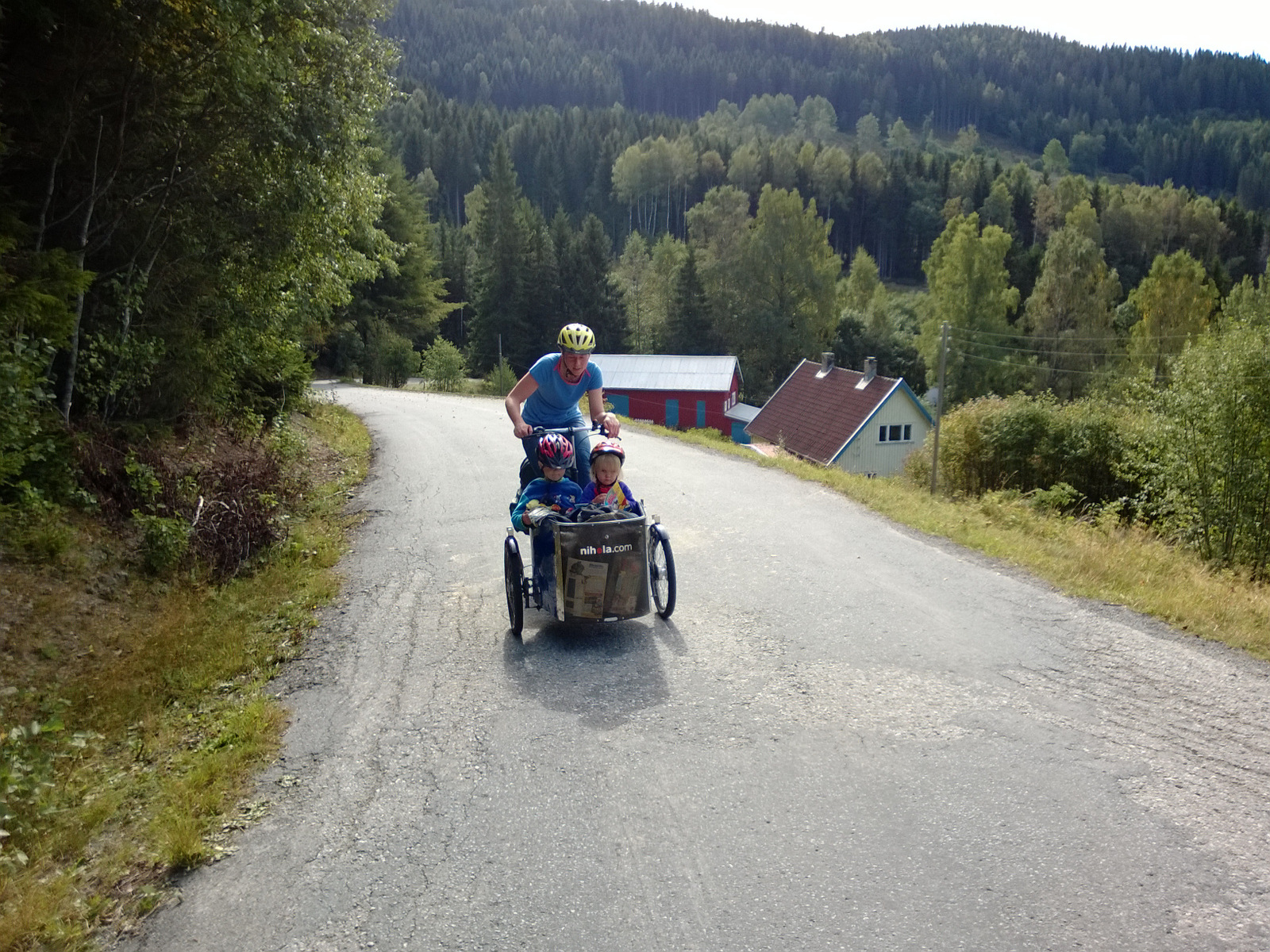
Its hard to photograph a hill, but this was a good one.
Climbing out of a valley on route from Hønefoss to Oslo.

So I should talk about how braking works on a Nihola.  The rear is either a coaster brake (foot brake) or a v-brake, but could in theory also be a different type of hub-mounted drum such as a roller brake (grease-filled drum from Shimano).  I estimate that there is zero possibility of a disc in the rear, the lack of mounts being a prominent problem, but also the shape of the frame appears incompatible, which is a shame because all the most interesting gear hubs are available with disc mounts.  Discs aren't perfect, but I'd take a disc over a rim brake on the rear wheel of a cargo bike.

Now, the rear brake doesn't necessarily need to be strong.  Ideally it is easy to modulate, to use whatever traction is available.  Foot brakes are not known for being strong, but are more than strong enough to skid the back tire on clean pavement (presuming no weight on the rear rack).  The reason that strength is not a problem is because of the significant forward weight transfer under hard braking, especially when weight is concentrated in the box, and also especially on downhill slopes.  This all is to say, the rear brake is generally of little use for quick stops.  This effect is more significant on a Nihola than a regular bike.

Regrettably, the brakes in front are also of little use for quick stops.  They are always 7cm Sturmey-Archer drums, a type of non-greased drum with a replaceable brake shoe.  One single-pull 4-finger lever pulls to a splitter which seeks to distribute force evenly between the left and right, or perhaps it just seeks to keep the cables to each side the same length.  There is, anyway, a splitter which has the potential to allow more cable to be pulled on one side than the other (this pulling is not smooth in my experience) and which has the potential to keep the cables to the front brakes roughly the same length.  It seems to me that the observable strength of the front brakes is usually mismatched if any particular strength can be observed at all, so the splitter is not an effective way to balance braking power.

The brakes, freshly adjusted, are strong enough that on flat ground, with an empty Nihola, I need to brace myself against the handlebar when doing a 100% stop.  Some exertion is required, but certainly no danger of going over the bars unless I could somehow brake without having my hands on them, and certainly no possibility of lifting the back tire off the ground.  Gradual and smooth is the idea.  This is mostly fine at reasonable speeds and on flat ground, but hills are more problematic.  By about 10% slope, I get the impression that the brakes are mostly there to prevent speed from increasing.  Stopping requires planning ahead.  The steeper the slope, the more planning ahead is required.  The brakes are sufficient to hold the trike in place to over 25%, which I suppose is evidence that stopping is possible at such a slope, but this will require the rear brake to be used without much skidding.  A skidding rear tire is not being very helpful.

Skidding the front tires is not easy to do.  The easiest way is to brake hard when turning sharp corners at speed.  Often, because the strength of the front brakes is likely imbalanced, this is possible turning one way and not the other.  About the only other time I've managed is when one brake arm is seized up, apparently causing the other brake to gain strength, which can skid a tire on gravel.  Load in the box makes skidding a lot harder.

The view on a day tour. 
Lots of people will say drums are a low-maintenance cycle brake, but I've spent plenty of time screwing around with the drums on my two Niholas since moving to Oslo.  Understandably, stopping 150kg of trike, cargo and rider on some of these hills can be demanding.  The brakes can easily get too hot to touch.  It rains, it snows, salt and/or other chemicals are sprayed around, there is sand and gravel, mud... sometimes I get plants caught up around the brakes, and often enough they stand outside in the weather.  Its true that little cleaning is required.  There is no particular seal on the brakes, just a design which makes it somewhat non-obvious for water to flow in.  Mostly that appears to get the job done, but if moisture enters, the brakes can be weaker while wet, and can rust a bit on the braking surface.  The rust wears off but appears to contribute to lumpy and/or squeaky braking.

Squeaking from the front brakes can be a major irritant, but can also be entirely nonexistant.  Its difficult for me to figure out what causes the squeaking or how it can be fixed.  Simply using the brakes more will only silence the squeaks until the brakes cool down again, and cleaning seems to have only a short-term effect, but sometimes the passage of time (or the change of weather) seems to change the squeaking situation.  I got though months of snow and melting this winter with perfectly quiet and predictable brake behavior for no reason I can see, although there was some squeaking a week or two after I tightened up front brake cables in the summer.  Squeaking is often associated with strong braking performance, but not always.  There is a possibility that getting the brakes very hot encourages squeaking the next time (next day) they are used.  Mysterious.

The center adjuster with its rubber cover pulled up.
So, maintenance.  The brake arms need to be lubed (drip or spray some oil at the base) or they will start to seize up, which can have interesting effects because it may start causing all cable movement to be "routed" to the easier-to-operate brake, in a crude way.  Definitely oil those arms.  Brake dust might need to be cleaned out from time to time.  Cable stretch and/or brake wear require the brake cable to be tightened, and this is the most interesting bit of service to perform.  For small adjustments, there is an adjuster in the center, above the splitter.  For big adjustments, I have found that the center adjuster should be slackened, the cable fastening bolts on each brake arm should be loosened, both brake arms should be fully engaged (full brake), and the fastening bolts should be tightened again.  So the brake arms are held some distance towards engagement permanently.  Surprisingly, this does not result in dragging brakes, merely a firm brake handle and optimized brake strength.  A brake handle which pulls up close to the handlebars indicates that braking strength could be improved.  In other words, it seems that more strength is delivered when the brakes engage early in the travel of the brake lever, even in the case of a brake lever that pulls a long way but does not touch the hand grip.  I don't know why that is, but the difference can be very noticeable.

The splitter, just a round thing that the brake cable is looped over.  Note center cable at the top.

An exposed brake, with the brake arm visible to the right.
A wrench being used to hold the brake arm fully engaged while the cable on the other side is fastened.
The drums behave strangely when asked to deliver 100%.  The strength seems to reach a certain level fairly easily, and then does not improve further, regardless of the force applied to the brake lever.  I expect that the cable liner running between the lever and the spitter has started to compress at that point.  Fitting a more compression-resistant section of cable liner could improve braking strength.  I've also been tempted to set up the left and right brakes with separate levers, using a foot brake for the rear.  This would have the potential to be a lot of fun on downhill corners.

I've noticed that Sturmey Archer makes a 9cm drum that almost fits on a Nihola, as far as I can tell from photos.  Certainly the Nihola company could make it fit with a small alteration to the piece of metal that is tasked with anchoring the top of the brake's back plate and the fender.  I imagine the 9cm drum would be stronger for the same cable tension, longer lasting, slower to heat, and make for a stiffer wheel (the front wheels have a hard life).

Anyway the brakes on a Nihola are probably the weakest link for 'ambitious' owners.

Gear hub madness

Today I came across a good description of how the new SRAM G8 hub works, and I worked through the ratios in a spreadsheet. Its a strange hub and it took me a while to figure out what was going on, even when someone had already attempted to explain it. This got me thinking about another difficult nut to crack, the Alfine 11.

As far as I can determine, no one has done a teardown of an Alfine 11, counted the teeth, or posted any particular information about how its ratios are created.  In the past, I've thought it was quite similar in design to a Nexus 7, but now I've changed my mind.  However before that, lets go on a tour of gear ratios in hubs.

Gear hubs are made up of planetary gear sets: http://en.wikipedia.org/wiki/Epicyclic_gearing

Generic three speed:

The most basic hubs have one gear set, giving three speeds.  In the middle there is direct drive, then one ratio increased and one ratio decreased (the inverse of the increased ratio).

gear 1 2 3
ratio 0,750 1,000 1,333
ratio change 33 % 33 %
name 1/A - A
calculated ratio 0,750 1,000 1,333

SRAM P5:

This was extended to make 5 speeds such as the SRAM P5 by placing two gear sets into one module, so that one of two ratios could be used at a time, either up or down.

gear 1 2 3 4 5
ratio 0,633 0,781 1,000 1,281 1,579
ratio change 23 % 28 % 28 % 23 %
name 1/A 1/B - B A
calculated ratio 0,633 0,781 1,000 1,281 1,579

SRAM S7:

This also worked for 7 speeds, such as the SRAM S7.

gear 1 2 3 4 5 6 7
ratio 0,574 0,677 0,809 1,000 1,236 1,476 1,742
ratio change 18 % 19 % 24 % 24 % 19 % 18 %
name 1/A 1/B 1/C - C B A
calculated ratio 0,574 0,678 0,809 1,000 1,236 1,476 1,742

SRAM i-Motion 9:

It even worked for a 9 speed, the i-Motion 9.  This hub was basically a failure on the market, apparently because it was too heavy, rough running, expensive, and poorly sealed against weather.  However it was apparently well constructed, and it did achieve 9 tight and evenly-spaced ratios while using only one planetary gear at a time, potentially giving high efficiency.  I think its a shame it didn't make it.

gear 1 2 3 4 5 6 7 8 9
ratio 0,542 0,621 0,727 0,853 1,000 1,172 1,375 1,611 1,844
ratio change 15 % 17 % 17 % 17 % 17 % 17 % 17 % 14 %
name 1/A 1/B 1/C 1/D - D C B A
calculated ratio 0,542 0,621 0,727 0,853 1,000 1,172 1,375 1,611 1,844

Shimano Nexus 4:

But there are other fun things that might be done.  Consider a Nexus 4, which made four ratios from a set of three planetary gears, by only increasing ratios.  Leaving out the ability to decrease ratios simplified the hub.  This simplification, where each planetary gear is only used to either increase or decrease ratio but not both, is a major theme of all recent hubs.  There i-Motion 9 above might well have needed only 4 planetary gears to get 9 beautiful-looking ratios, but those 4 gears were too complicated.

gear 1 2 3 4
ratio 1,000 1,244 1,500 1,843
ratio change 24 % 21 % 23 %
name - A B C
calculated ratio 1,000 1,244 1,500 1,843

Shimano Nexus 5:

But all these hubs have fairly large steps between the gears.  Especially the gap between direct drive and the first ratio up or down was problematic.  While i-Motion 9 got this down to 17%, it was apparently unpleasant.  Even the 22% gap on Nexus 8 leads to some gear whine.  So Shimano got busy with dual-stage compounding its planetary gear sets.  Below is the Nexus 5, which used three planetary gears in two sets, and has no direct drive ratio at all, but is very smooth in my experience.

gear 1 2 3 4 5
ratio 0,750 1,001 1,159 1,335 1,545
ratio change 33 % 16 % 15 % 16 %
name 1/A B/A C/A B C
calculated ratio 0,750 1,001 1,159 1,335 1,545

Shimano Nexus 7:

The Nexus 7 is similar, but with four planetary gears arranged in two sets.  I've used two of these extensively and never been satisfied with either their smoothness or efficiency, but they seem to sell in vast quantities in Denmark.

gear 1 2 3 4 5 6 7
ratio 0,632 0,741 0,843 0,989 1,145 1,335 1,545
ratio change 17 % 14 % 17 % 16 % 17 % 16 %
name 1/A 1/B C/A C/B D/B C D
calculated ratio 0,632 0,741 0,844 0,989 1,145 1,335 1,545

Shimano Nexus 8 / Shimano Alfine 8:

But thats not the only way to do multi-stage compounding.  The Nexus/Alfine 8 is a lot like the old Nexus 4 with a new planetary gear enabling the four original ratios to be used twice.  This leaves a direct drive gear in place which is good, but creates an odd situation where the least efficient gear (4) is right next to the most efficient (5), and switching between the "high" and "low" gears can be problematic.  Still, this seems to be a robust design.

gear 1 2 3 4 5 6 7 8
ratio 0,527 0,644 0,748 0,851 1,000 1,223 1,419 1,615
ratio change 22 % 16 % 14 % 18 % 22 % 16 % 14 %
name 1/A B/A C/A D/A - B C D
calculated ratio 0,527 0,645 0,748 0,851 1,000 1,223 1,419 1,615

Rohloff:

And then there is the monsterous 14 speed Rohloff, that uses 5 planetary gears in three sets.  Gears 3 and 5 actually use triple-stage compounding, which is hard to notice in my experience.  In some ways this combines concepts which are found on both Nexus 7 and Nexus 8, sort of a combination of those designs.

gear 1 2 3 4 5 6 7 8 9 10 11 12 13 14
ratio 0,279 0,316 0,360 0,409 0,464 0,528 0,600 0,682 0,774 0,881 1,000 1,135 1,292 1,467
ratio change 13 % 14 % 14 % 13 % 14 % 14 % 14 % 13 % 14 % 14 % 14 % 14 % 14 %
name 1/B * 1/A 1/C * 1/A D/B * 1/A 1/A E/C * 1/A D/A E/A 1/B 1/C D/B - E/C D E
calculated ratio 0,279 0,317 0,360 0,409 0,464 0,528 0,600 0,682 0,774 0,881 1,000 1,135 1,292 1,467

SRAM G8:

Here is the SRAM G8 in all its confusing glory.  Five planetary gears in two sets, sort of arranged like a backwards Nexus/Alfine 8.  No direct drive, and 6 of the 8 ratios are two-stage compounded.  http://sheldonbrown.com/sram-g8.html

gear 1 2 3 4 5 6 7 8
ratio 0,609 0,710 0,803 0,903 1,054 1,204 1,355 1,581
ratio change 17 % 13 % 12 % 17 % 14 % 13 % 17 %
name 1/B 1/C E/A E/B E/C D/A D/B D/C 1/A D E
calculated ratio 0,609 0,710 0,803 0,904 1,054 1,204 1,356 1,580 0,5411 2,2258 1,4839

Shimano Alfine 11:

Then finally we get to the Alfine 11.  I spent some time on this.  There are lots of ways to make a good approximation of the published ratios, but the way I am most satisfied with uses four planetary gears arranged in three sets.  The main difference between this and Nexus/Alfine 8 is that one gear (number 7) is able to combine with gears 8 and 9 to create ratios 10 and 11.  Then all those resulting 5 ratios are re-used in positions 2-6.  This very nicely explains the 29.2% gap between gears 1 and 2... its same ratio as gear 7 has.  This also has no planetary gears which are used to both increase and decrease ratios, which appears to be very much out of style, it explains the alternating 13% and 14% ratio changes, and it explains how the 11 speed is able to match the weight of the 8 speed.  Essentially, the same number and strength of gears needed to be used.

There is no direct drive ratio, which is instead replaced by a triple-compound approximation, I imagine to achieve mechanical simplicity.  The only difference between 2-6 and 7-11 is whether or not the "low range gear" is active.

gear 1 2 3 4 5 6 7 8 9 10 11
ratio 0,527 0,681 0,770 0,878 0,995 1,134 1,292 1,462 1,667 1,888 2,153
ratio change 29,2 % 13,1 % 14,0 % 13,3 % 14,0 % 13,9 % 13,2 % 14,0 % 13,3 % 14,0 %
name 1/A B/A C/A D/A (B*C)/A (B*D)/A B C D B*C B*D
calculated ratio 0,527 0,681 0,770 0,879 0,995 1,135 1,292 1,462 1,667 1,889 2,154

Further reading, here is the grand daddy of complicated bike gear hubs: http://sheldonbrown.com/elanratios.html

Friday, February 21, 2014

Nexus 8 SG-8C20

When I broke the SRAM P5 that came with our blue Nihola, we spent considerable time trying to find the right replacement.  It would have been a Nuvinci N360 with a roller brake, except the shop in England selling N360's wasn't really interested in ordering one with a roller brake mount, and bike shop employees in Denmark seemed to have little time for "strange" hub gears.  Basically people were not interested in being paid to do anything they didn't normally do; perhaps the margins were too small for them to care.

The Shimano Nexus 8 with foot brake would be another good option, except in Denmark (and some other countries) it was only possible to order the old SG-8C20 version.  It seemed that Shimano refused to sell the SG-8C31 until the old model was sold out (on a per-country basis), and no one could order one for me, nor could I find any for sale online.

I also considered the SG-8R36 with a roller brake, but it was more expensive and we wanted to stick with a coaster brake (foot brake) unless we had a really good reason to change.

So we ordered the old model, the SG-8C20.  It had probably been sitting on a warehouse shelf for years.  I installed it myself.  Right away I had some issues because the "cassette joint" wanted to occupy a bit of space which the chainstay was using.  I installed some extra washers and bent the cassette joint a little to get the shifting in order, but the whole thing was always a pain to fiddle with.

The hub itself was functional, but made me nervous that it was headed for premature death.  From day #1 it made various clicks and had various shifting issues between gears 4 & 5.  Gear 5 (direct drive) seemed like it might slip at any time (but it never actually slipped, except after shifting from 4th).  Adjustment of the shifter could address the various issues but always at a cost somewhere else.  At some point, the clicking and humming alone was enough for me to know what gear my wife was pedaling in, if I rode along behind her.  Still, it was working.

Happily it seems there are ways to address these problems.

The Nihola company had started using Nexus 8 hubs (I presume SG-8R31), so when visiting Copenhagen I checked with them to see how they handled the cassette joint.  Turns out they had some different non-turn washers that I didn't realize existed: 5L and 5R.  They sold me a set of them for a reasonable cost, and one source of irritation dissappeared.


On my next visit to Denmark I took the Nexus 8 into Byman Cykler and had them put some new grease in it.  Now this was the magic the hub needed.  Most of the noises and shift problems vanished and haven't come back (in over 4 months).  So, moral of the story: hubs like fresh grease.

There is one lingering irritation with this hub, however.  It works its axle nuts loose over time, and then pulls itself crooked in the frame.  I guess I'm putting too much torque on it.  Always carry a 15mm wrench!

So now I can make a bit of a verdict on the Nexus 8 with coaster brake as a hub for a Nihola.  Its pretty good.  A bit rough in 3rd and especially 4th gear, in fact its generally a rough hub.  Buts its strong: ours is set up with a 24t sprocket on the hub and 38t on the crank, well beyond any ratio any hub company endorses, and I've put my entire weight on it countless times, plus added arm strength.  I've gotten small blisters from pulling on the handles to force the pedals around.  (I do these terrible things in 1st gear exclusively, which is probably the strongest gear available.)

The Nexus 8 is a strange hub.  Its not symmetric (i.e. the top ratios are not mirror images of the bottom ratios) and the least efficient gears are in the middle of the range (3 & 4) rather than the ends.  However this works out well enough on a Nihola.  For any real hill, I just drop to 1st gear and pedal.  On any reasonably flat ground, I can stick to gears 5-8, which are mostly pleasant.  I never make any strenuous effort in 3rd or 4th gears.

The foot brake is strong enough to slide the rear tire at will, though Oslo hills might cook the hub.  More than once I have been unable to touch the hub's shell after a good downhill.  After that happened a few times, I decided to have a V-brake installed in addition to the foot brake, so now that Nihola has two rear brakes.  Overall I am very pleased with the foot brake.  I'm convinced foot brakes are the best rear brakes for Niholas, except possibly in deep snow, ice, or mud.

But is the Nexus 8 a worthy upgrade over a SRAM P5?  For any moderately serious cyclist, I would say yes.  The ratios are closer, which makes it easier to go fast without knee injuries.  The lowest ratio is good and low.  The hub itself is stronger.  It shifts easier.  Its easier to handle a freezing shift cable.  There is no "clickbox" sticking out in the way of pannier bags.  On the other hand, the P5 is a lot smoother in operation, its likely a bit more efficient, and it doesn't take tools to disconnect its shift cable.

Anyway, Nexus 8 is a good Nihola hub.